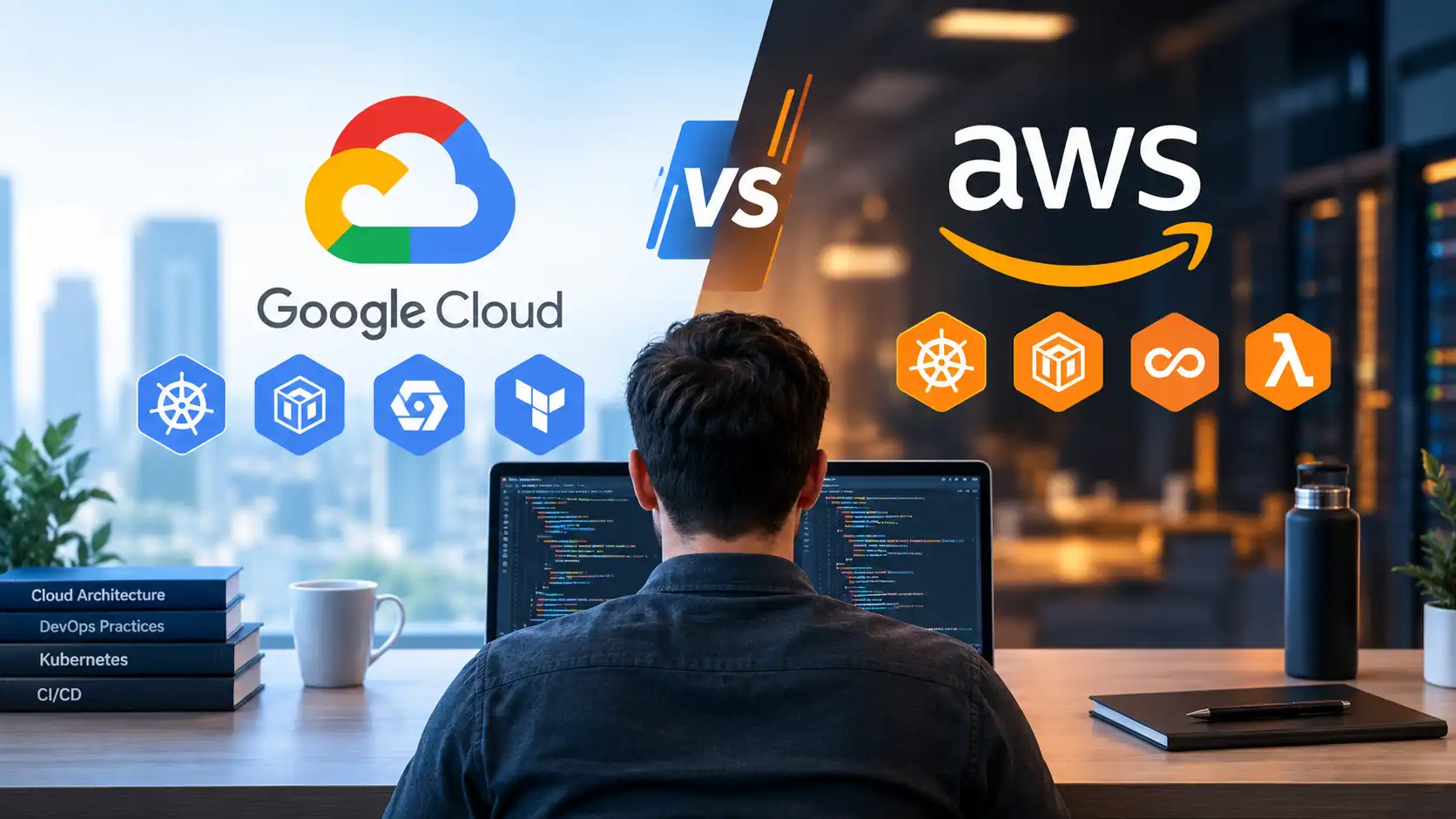
Both platforms run containers, pipelines and infrastructure as code. The career question is not which technology is superior. It is which platform puts your CV in front of more hiring managers, and which one has fewer candidates competing for each opening. Those two forces pull in opposite directions, and that tension is the real decision.
Market Reality and What It Means for Hiring
In the first quarter of 2026, AWS held roughly 28 percent of global cloud infrastructure spend, Microsoft Azure roughly 21 percent, and Google Cloud roughly 14 percent, in a market worth 129 billion dollars for the quarter and growing 35 percent year on year.
Translate that into hiring. AWS generates the largest absolute number of DevOps openings worldwide and the deepest freelance demand. Google Cloud generates fewer openings but has a materially smaller certified candidate pool, especially in Pakistan. More openings means more chances. Fewer competitors means better odds per opening. Your decision depends on which of those two you need more.
How the Two Roles Differ in Practice
The AWS DevOps Toolchain
AWS gives you many primitives and expects you to assemble them. You will work with CodePipeline, CodeBuild and CodeDeploy or GitHub Actions, CloudFormation or Terraform, ECS and EKS, CloudWatch and X-Ray, and IAM policies written by hand. Breadth of service knowledge matters. Multi-account governance through Organizations and Control Tower is a senior-level differentiator.
The Google Cloud DevOps Toolchain
Google Cloud is more opinionated and more Kubernetes-native. You will work with Cloud Build, Artifact Registry, Google Kubernetes Engine, Cloud Deploy, Cloud Operations for monitoring and tracing, and Terraform as the default infrastructure language. Site reliability engineering practice is baked into the platform narrative, so error budgets, service level objectives and toil reduction appear directly in the exam and in interviews.
The practical implication: Google Cloud DevOps work assumes stronger Kubernetes and SRE fundamentals earlier, while AWS DevOps work assumes broader service knowledge earlier.
Head-to-Head Comparison
| Dimension | AWS DevOps | Google Cloud DevOps |
| Global infrastructure share, Q1 2026 | About 28 percent | About 14 percent |
| Job volume | Highest of the three major platforms | Lower volume, growing |
| Candidate competition | Heavy, especially at associate level | Lighter, fewer certified candidates in Pakistan |
| Freelance and marketplace demand | Strong, most client requests name AWS | Limited, mostly data and analytics projects |
| Kubernetes centrality | Important but optional at entry level | Central from the start |
| SRE emphasis | Present, less formalised in certification | Explicit, tested directly |
| Data and machine learning adjacency | Broad service range | Frequently the reason employers chose the platform |
| Learning curve shape | Wide and shallow first, deep later | Narrow and deep from the start |
| Best fit | Export software houses, startups, freelancing | Data-heavy employers, Kubernetes-first engineering teams |
For a broader platform-level view of the same question, read Google Cloud vs AWS: which cloud platform should you learn first.

Certification Comparison
| Credential | Fee | Format | Recommended experience | Validity |
| Google Associate Cloud Engineer | 125 USD | 2 hours, 50 to 60 questions | 6 or more months hands-on with Google Cloud | 3 years |
| Google Professional Cloud DevOps Engineer | 200 USD | 2 hours, 50 to 60 questions | 3 or more years industry experience, 1 or more managing production on Google Cloud | Renewable within the eligibility window |
| AWS Certified Solutions Architect Associate | 150 USD | 130 minutes, 65 questions | 1 or more years designing AWS solutions | 3 years |
| AWS Certified DevOps Engineer Professional, DOP-C02 | 300 USD | 180 minutes, 75 questions | 2 or more years provisioning and operating AWS | 3 years |
Two details matter for budgeting. Google offers a discounted renewal path for the Associate Cloud Engineer at 125 USD for the full exam and 75 USD for the one-hour renewal covering 20 questions. The AWS professional exam costs 300 USD and doubles the question count of the associate, so the failure cost is higher. Google Cloud exams are currently offered in English and Japanese for the DevOps professional, which is worth noting if language is a factor for you.
Entry points in Pakistan: the Google Associate Cloud Engineer course or the AWS Solutions Architect Associate track. Professional level: the Google Professional Cloud DevOps Engineer programme or the AWS DevOps Engineer Professional programme.
Pakistan-Specific Decision Factors
| Factor | Favours AWS | Favours Google Cloud |
| Local job listings | Yes, AWS appears in more Pakistani DevOps postings | No, but each listing draws fewer qualified applicants |
| Freelance income | Yes, most marketplace briefs name AWS by default | Rarely requested by small clients |
| Export client mandates | Yes, common for US and Gulf clients | Occasional, usually data-driven organisations |
| Employer already running Kubernetes | Neutral | Yes, Google Kubernetes Engine is a common landing point |
| Data, analytics or machine learning workloads | Neutral | Yes, BigQuery and Vertex adjacency is a hiring driver |
| Exam access and payment | Both require a card enabled for international transactions | Same requirement |
| Community and local study groups | Larger AWS community in Pakistan | Smaller, which means less peer support but less noise |
Decision Matrix: Pick by Goal, Not by Preference
| Your goal | Choose | Reason |
| First DevOps job as fast as possible | AWS | Largest number of openings gives you more shots on goal |
| Freelance or agency income | AWS | Client briefs name AWS far more often |
| Differentiate in a crowded applicant pool | Google Cloud | Fewer certified candidates competing per opening |
| Move toward site reliability engineering | Google Cloud | SRE practice is explicit in the certification and the platform |
| Work on data or machine learning platforms | Google Cloud | Employers often chose the platform for its data stack |
| Your current employer already runs one platform | That platform | Internal experience beats external certification every time |
| Target multinational enterprises in Pakistan | AWS first, then a second platform | Large estates are usually multi-cloud in practice |
The Both-Platforms Path and When It Pays
Multi-cloud competence is valuable, and it is also a trap for beginners. Learn one platform to production depth first. The transferable core is identical: Linux, networking, containers, Kubernetes, Terraform, CI/CD design, observability and incident response. Once that core is solid, the second platform takes roughly six to eight weeks because you are learning service names rather than concepts.
That transferable core is why the Certified Kubernetes Administrator programme and the Terraform Associate certification hold value regardless of which cloud you pick. They are the two credentials that survive a platform switch intact.
Frequently Asked Questions
Which pays more, AWS or Google Cloud DevOps?
Pay tracks seniority and employer type far more than platform. In Pakistan, the practical difference is that Google Cloud roles concentrate in fewer, usually larger employers, while AWS roles spread across many employers at every size.
Can I start with Google Cloud as a complete beginner?
Yes. The Associate Cloud Engineer recommends six or more months of hands-on experience and has no formal prerequisite. Expect to learn Kubernetes earlier than you would on AWS.
Will Google Cloud overtake AWS?
Google Cloud has been growing faster from a smaller base, but it held roughly half of Azure share and half of AWS share in Q1 2026. Plan your next three years on current demand, not on a projected reversal.
Do employers care which platform my certification is on?
They care whether it matches their estate. A certification in the platform your target employer already runs is worth considerably more than a broader credential in one they do not use.
Is cloud still a good career choice at all?
Cloud infrastructure spend grew 35 percent year on year in Q1 2026. Our analysis of whether cloud computing is still a good career choice covers the demand picture in more detail.
Choose a Platform and Commit for Six Months
The worst outcome is six months split across two platforms producing shallow competence in both. Pick using the decision matrix above, then commit. Explore the Google Cloud training track including the Professional Cloud Engineer path, or the AWS certification track. Browse the full course catalogue or speak to a training advisor who can match the platform to the employers you actually want to work for.