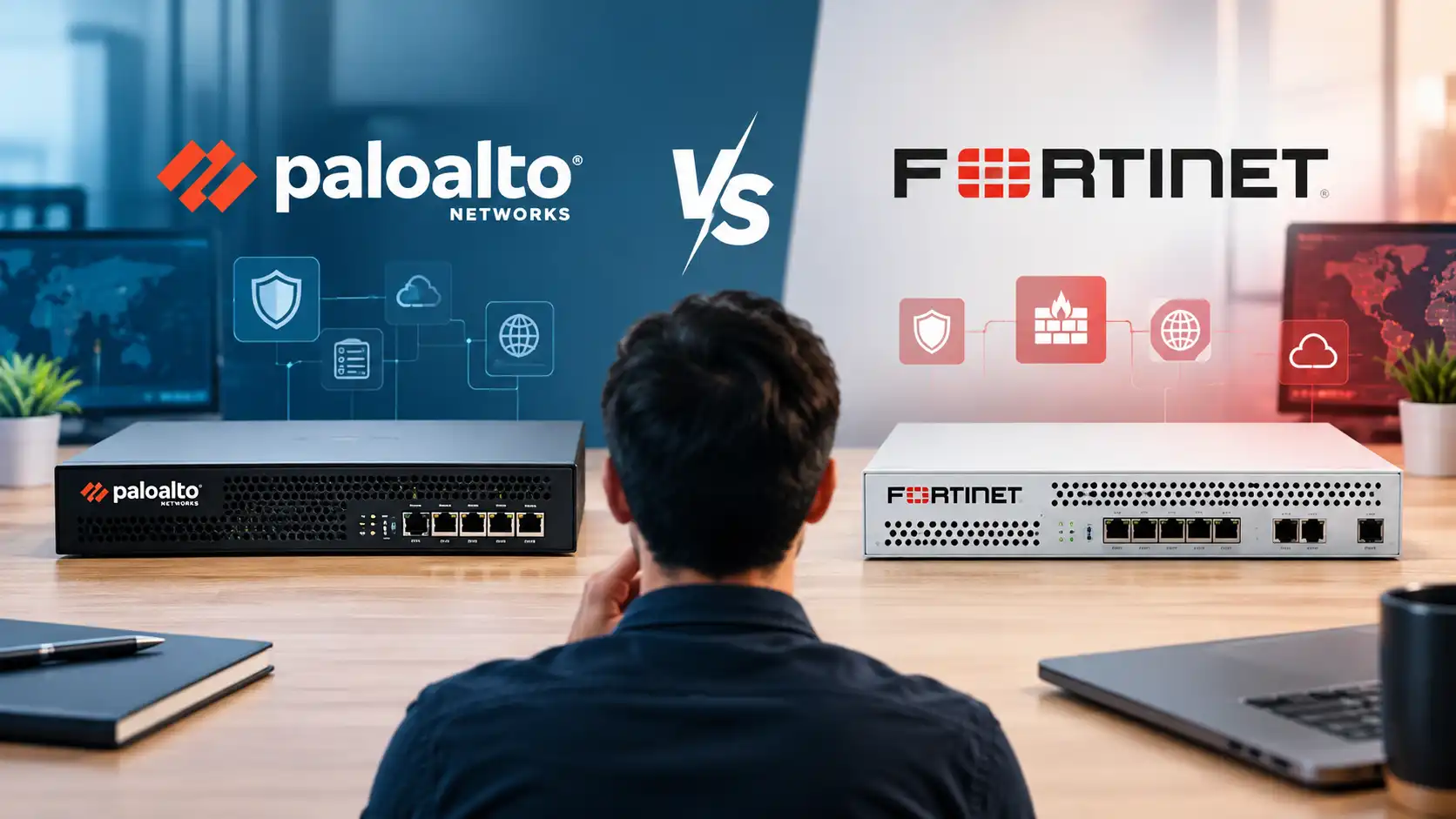
This is not a product review. Both vendors build capable next-generation firewalls, and both are consistently positioned as Leaders in industry firewall analysis alongside Check Point. The career question is different: which skill converts into a job faster in Pakistan, and what happens to your knowledge if you later switch. This answers both.
Vendor Positioning Compared
| Dimension | Fortinet | Palo Alto Networks |
| Analyst positioning | Consistently placed among the leaders in enterprise firewall analysis | Consistently placed among the leaders in enterprise firewall analysis |
| Typical price positioning | Strong price to performance, widely adopted by small and mid-sized organisations | Premium positioning, concentrated in large enterprise and specialised security estates |
| Deployment breadth | Very broad, from small branch appliances to large enterprise and telecom estates | Concentrated in larger enterprises, technology firms and security-mature organisations |
| Product ecosystem | Integrated security fabric spanning networking, endpoint, cloud and access | Deep security operations, cloud security and extended detection portfolio |
| Where the platform is strongest | Consolidating networking and security in one appliance at attractive cost | Advanced threat prevention and security operations at enterprise scale |
| Learning curve | Approachable, unified interface across the product range | Steeper, with distinct concepts to internalise before productivity |
Certification Structures Compared
Both vendors restructured their certification programmes recently, which is worth knowing before you buy study material.
| Aspect | Fortinet | Palo Alto Networks |
| Programme structure | NSE programme, expanded from five levels to eight effective 15 July 2026, organised around four tracks: Secure Networking, Security Operations, Cloud Security and SASE | Four tiers: foundational, professional, specialist and architect |
| Foundational tier | Cybersecurity fundamentals training, reorganised and expanded in the 2026 update | Cybersecurity Apprentice and Cybersecurity Practitioner |
| Professional tier | NSE 4 level, covering FortiGate network security administration | Network Security Professional, Security Operations Professional, Cloud Security Professional |
| Advanced tier | NSE 7 level, with new comprehensive examinations introduced in 2026 | Specialist credentials including Next-Generation Firewall Engineer, SD-WAN Engineer and Security Service Edge Engineer |
| Expert or architect tier | NSE 8, with recertification points carrying a two-year expiration | Network Security Architect and Security Operations Architect |
Because both programmes changed recently, verify current exam names, codes and fees at the point of booking rather than relying on older study guides. Programme restructuring is the most common reason candidates buy the wrong material.
The Pakistan Market Test
Ignore global product debates and ask a narrower question: which firewall is installed in the organisations that will interview you?
| Employer segment in Pakistan | More likely to run | Why |
| Small and mid-sized businesses | Fortinet | Price to performance and consolidated features suit constrained budgets |
| Managed security service providers | Fortinet, often alongside others | Cost per customer matters in a multi-tenant service model |
| Banks and large financial institutions | Both, frequently in a layered architecture | Regulated estates often deploy more than one vendor deliberately |
| Telecom operators | Both | Scale and segmentation requirements justify multiple platforms |
| Multinational subsidiaries | Follows the global parent standard | Local IT rarely chooses the vendor |
| Government and public sector | Varies by procurement cycle | Tender-driven rather than preference-driven |
The practical takeaway for a first job in Pakistan: Fortinet appears across a wider range of employer sizes, which means a larger number of entry-level opportunities. Palo Alto skills concentrate in fewer, larger organisations that typically want prior security experience. Breadth wins at entry level.
Decision Framework: Which to Learn First
| Your situation | Learn first | Reasoning |
| No security experience, want a first job in Pakistan | Fortinet | Wider employer base across company sizes means more entry openings |
| Already employed where one vendor is installed | That vendor | Hands-on estate access beats any certification you study in isolation |
| Targeting a large multinational or technology enterprise | Palo Alto Networks | Concentrated in exactly that segment |
| Targeting managed security services or SME consulting | Fortinet | Dominant in the budgets those clients operate under |
| Moving toward security operations rather than networking | Either, then add detection skills | SOC roles value analysis and correlation over device syntax |
| Planning to emigrate or work remotely for foreign employers | Learn one, then add a vendor-neutral credential | Neutral credentials travel better across unfamiliar estates |
| Already hold one vendor credential | Add breadth, not a second firewall vendor | Cloud security or detection adds more value than a second device syntax |

What Actually Transfers Between the Two
This is the part that removes the anxiety from the choice. Most of what you learn is not vendor-specific.
| Knowledge area | Transfers between vendors? | Comment |
| TCP/IP, routing, switching, subnetting | Fully | Vendor independent and the real foundation of the job |
| Policy design and least privilege thinking | Fully | The reasoning is identical, only the interface differs |
| Network segmentation architecture | Fully | Design skill, not product skill |
| Secure connectivity and authentication concepts | Largely | Protocols are standard, configuration steps differ |
| Threat inspection concepts | Largely | Feature naming differs, purpose does not |
| Logging, evidence handling, incident support | Largely | Log formats differ, investigative method does not |
| Command syntax and interface navigation | Not at all | The only genuinely vendor-locked layer, and the fastest to relearn |
| High availability and upgrade procedures | Partly | Concepts transfer, mechanics are product specific |
Roughly 70 to 80 percent of firewall competence is vendor neutral. That is why the sequencing question matters less than beginners fear, and why the real risk is delaying a decision rather than making the wrong one. Networking fundamentals through CCNA training are the part that pays back under either vendor.
The Learn-Both Sequence
If your long-term goal is security architecture, you will eventually touch multiple platforms. Sequence it like this.
Months 0 to 3. Networking fundamentals and vendor-neutral security foundations. CompTIA Security+ training covers the concepts every interview assumes, and Certified in Cybersecurity training is a faster entry point if you are starting from zero.
Months 4 to 9. One vendor to hands-on competence. In the Pakistani market that usually means Fortinet NSE4 training, because it opens the widest set of entry-level roles.
Months 10 to 18. Depth in that vendor plus detection skills. Fortinet NSE7 training builds advanced design, and CompTIA CySA+ training adds the analysis capability that SOC roles require.
Year two onward. Add the second vendor only if your employer runs it, or move toward architecture and governance credentials such as CISSP. A second firewall vendor adds less career value than cloud security or security leadership at that stage.
Frequently Asked Questions
Which vendor pays more?
Pay tracks seniority, sector and employer size far more than vendor. Palo Alto skills concentrate in larger organisations that often pay more, but those roles also expect more prior experience. At entry level the difference is not meaningful.
Is it bad to specialise in one vendor?
Only if you stop there. One vendor credential plus one vendor-neutral credential is a resilient combination. Two credentials from the same vendor and nothing else is not.
How hard is it to switch vendors later?
Six to ten weeks of focused study for an engineer who already understands policy design and networking. You are learning an interface, not a discipline.
Should I learn cloud firewalls instead?
Learn physical and virtual appliance concepts first. Cloud native controls make far more sense once you understand what they are replicating, and most Pakistani employers still run appliances at the perimeter.
Do employers ask for a specific certification or for experience?
Job adverts ask for certification. Interviews test experience. Use the credential to reach the interview and lab evidence to pass it.
Pick One, Start This Month
The wrong move is spending three months comparing vendors instead of learning either. Most of the skill transfers, and the Pakistani entry market rewards breadth of employer coverage. Review our training approach and lab facilities, browse the full course catalogue to see how the security sequence is structured, read more career guidance on our blog, or speak to a training advisor who can check which platforms your target employers actually run.
Data sources: Palo Alto Networks official certification page listing current certification tiers, accessed September 2026. Fortinet Training Institute help desk statement on 2026 NSE programme changes. Industry firewall leadership positioning as reported in Gartner Magic Quadrant coverage, 2026.